The fourth season of excavations at the Karfi site in the Lasithi Mountains, Crete, is coming to an end. This year we worked in three sectors of this highest situated (approx. 1140 m above sea level) and the largest mountainous defensible settlement in Crete, representing the period of collapse of the previous Minoan-Mycenaean settlement pattern around 1200 BC. Because the settlement was abandoned (after its destruction) around 1000 BC, Karfi offers a unique opportunity to trace both its genesis and its end – a period that reflects the least known phase of the crisis after 1200 BC.
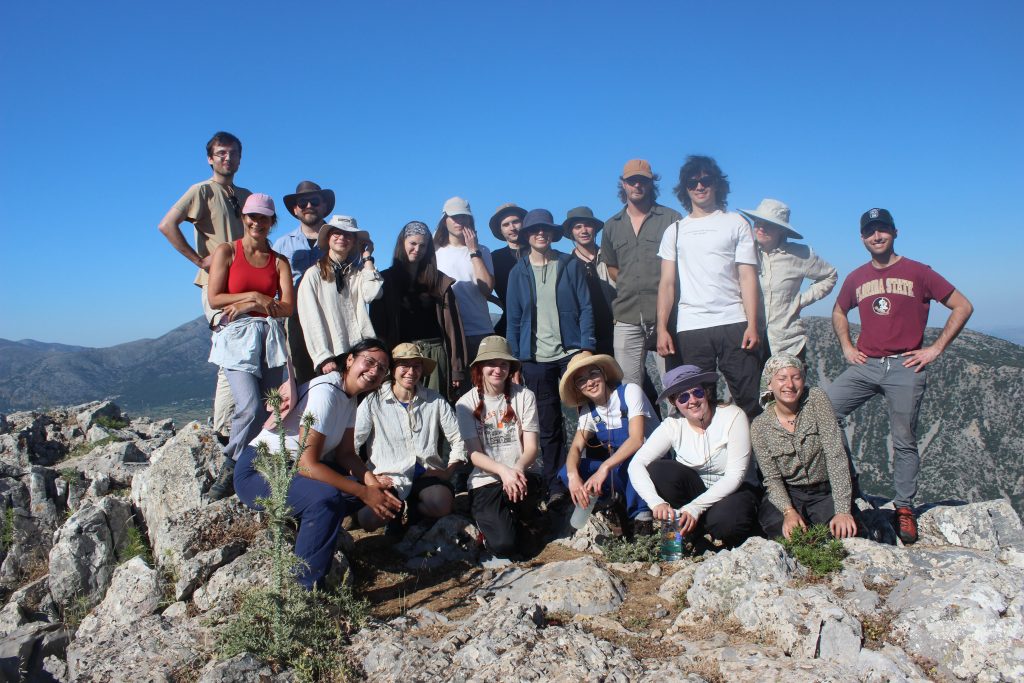
However, this archaeological site, partially excavated by John Pendlebury in the 1930s, offers a vast amount of information concerning not only the transition from the Bronze Age to the Early Iron Age, but also earlier episodes, such as the origins and nature of ritual sites in the Early and Middle Bronze Ages. This year, the team consisted of students from Poland (University of Adam Mickiewicz in Poznań and Warsaw University), Greece, Italy, France, the UK, the Netherlands, and the USA. As in previous years, the excellent cooperation with the Ephorate of Antiquities of Heraklion, as well as the help offered by the local community and, especially worth mentioning, the cordial support from the Monastery of Kera, made our work possible.
The work is being carried out as part of the National Science Centre OPUS project entitled “Identifying socio-economic breakdown and innovations in the organization of societies after the collapse of the political system around 1200 BCE – a new excavation program at Karfi, Crete,” a continuation of earlier surface and survey research. The work is also financially supported by the Loeb Classical Library Fellowship (Harvard).
Text by Prof. Krzysztof Nowicki