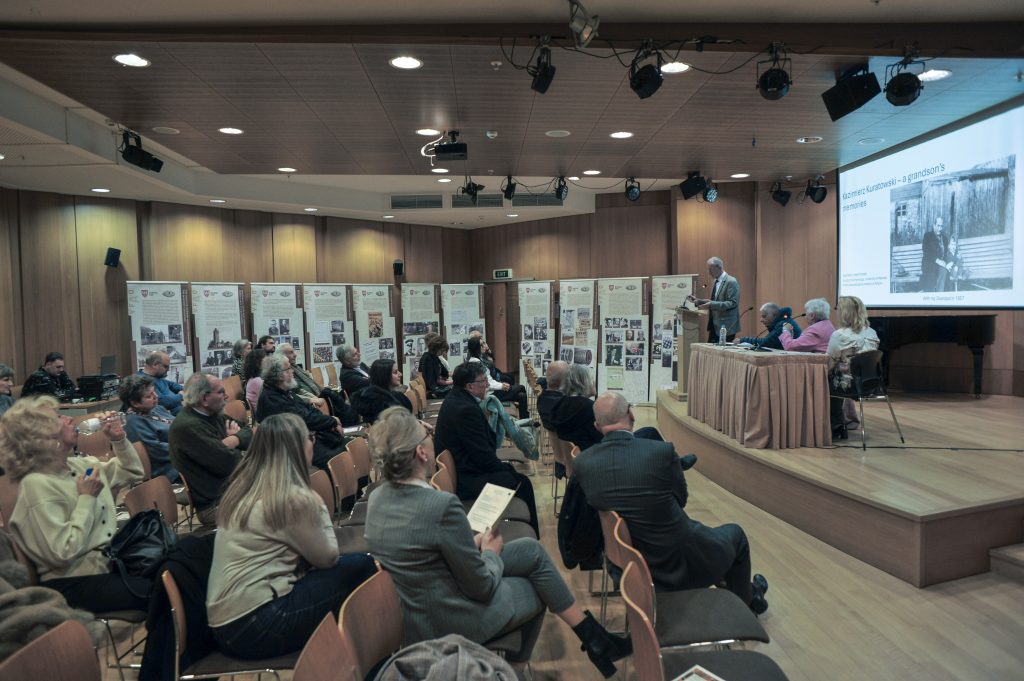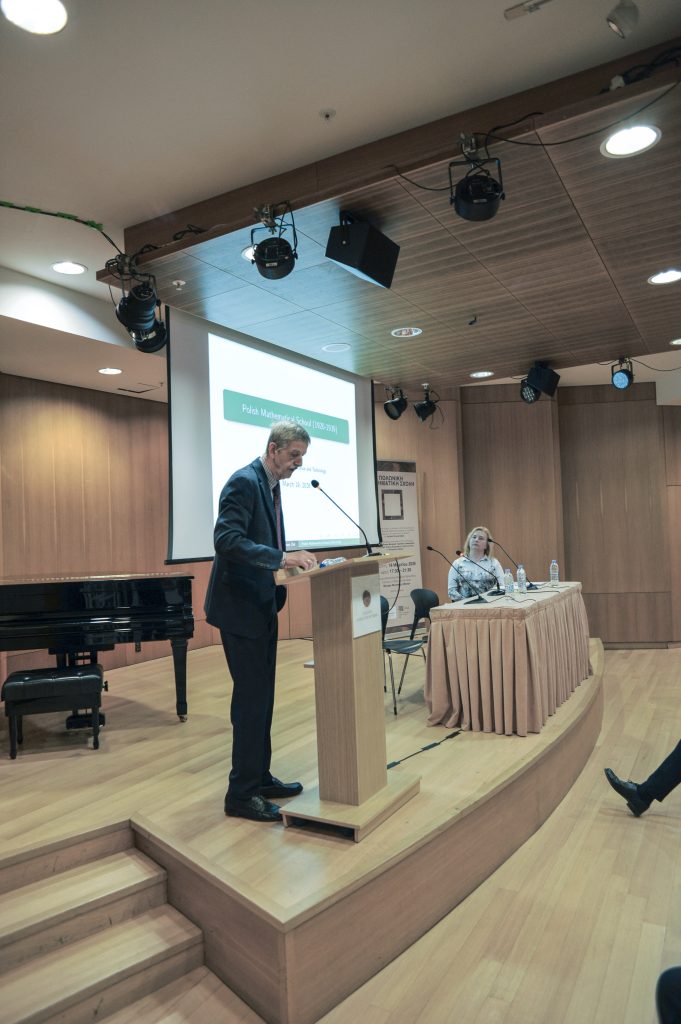
On 19 March 2026, a seminar devoted to the history of the Polish School of Mathematics was held at the Athens Concert Hall (Megaron – The Athens Concert Hall). The event was organised to mark the 130th anniversary of the birth of one of Poland’s most distinguished mathematicians, Prof. Kazimierz Kuratowski. The seminar, which brought together speakers from Poland and Greece, was made possible through the cooperation of the Embassy of the Republic of Poland in Athens, the Polish Archaeological Institute at Athens (PAIA), and Ms Edyta Kosiel-Evangelou, who was also the originator of the project.
The symposium was opened by the Ambassador of the Republic of Poland to Greece, Mr Wojciech Ponikiewski, and Prof. Kazimierz Lewartowski, Chair of the Scientific Council of the Polish Archaeological Institute at Athens (PAIA). The event was moderated by the Secretary-General of PAIA in Athens, Ms Beata Kukiel-Vraila.
In the first part of the evening, Prof. Tomasz Żak of the Wrocław University of Science and Technology presented the history of the Polish School of Mathematics, outlining its historical context and discussing the most important concepts developed by Polish scholars. This was followed by a lecture by Prof. Roman Murawski of Adam Mickiewicz University in Poznań, who addressed the history of the Warsaw–Lwów School of Logic and introduced the leading Polish logicians of that period. The global impact of the Polish School of Mathematics was then discussed by Prof. Stelios Negrepontis of the National and Kapodistrian University of Athens, who compared its interwar flourishing to the golden age of mathematics in classical Greece.
The second panel, devoted to the figure of Prof. Kazimierz Kuratowski, opened with a presentation by Prof. Kazimierz Lewartowski of the University of Warsaw, grandson and namesake of the eminent mathematician. Prof. Lewartowski shared family anecdotes and personal recollections, revealing lesser-known aspects of his grandfather’s life. Subsequently, Prof. Christina Phili of the National Technical University of Athens spoke about her encounter with Kazimierz Kuratowski and outlined his stature as a scholar of international renown. She emphasised that he was not only one of the leading representatives of the Polish School of Mathematics, but also its first historian and a co-creator of post-war academic life in Poland following the devastation of the Second World War. In the final presentation, Prof. Panagiotis Spyrou of the National and Kapodistrian University of Athens shared his personal reflections on engaging with the Polish mathematical tradition.
The symposium concluded with a screening of a short documentary film devoted to the role of Polish mathematicians in deciphering the Enigma code used by Germany during the Second World War.
The audience, which included representatives of Polish and Greek mathematical communities, historians of science, as well as members of the broader Greek public and the Polish diaspora in Greece, also had the opportunity to view the exhibition “Enigma: Decoding Victory”. The exhibition presented the achievements of a team of scientists from Poznań University (now Adam Mickiewicz University in Poznań), whose work significantly contributed to the eventual decryption of German codes encrypted using the Enigma machine, thereby helping to shorten the Second World War.
The exhibition, prepared by the Marshal Office of the Greater Poland Voivodeship, was presented in Athens thanks to the efforts of the Director of PAIA, Prof. Janusz Czebreszuk, and the support of the Embassy of the Republic of Poland in Athens. We extend our sincere gratitude to Mr Marek Woźniak, Marshal of the Greater Poland Voivodeship, for his assistance in the realisation of the project.
Prepared by: Beata Kukiel-Vraila
Photographs: Mateusz Kula